MILITARY HISTORY
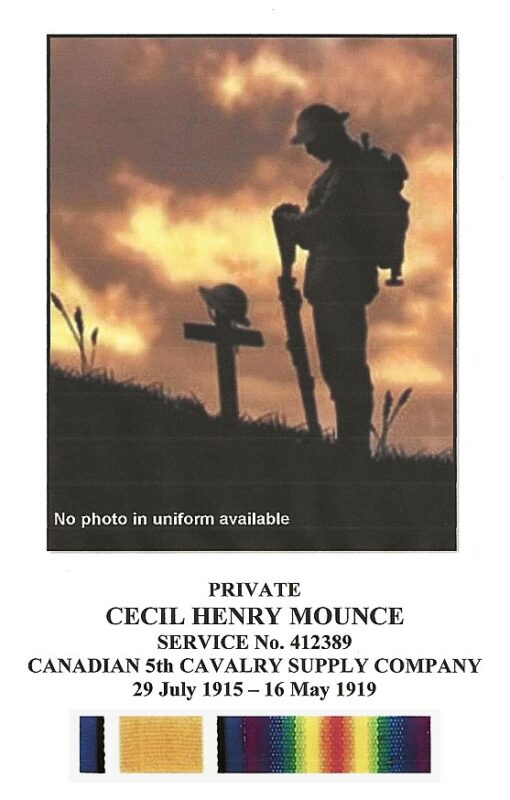
PRIVATE CECIL HENRY MOUNCE – No. 412389 – Active Service (World War I)
On May 8, 1915, Cecil Henry Mounce answered his nation’s call, completing his attestation for the Canadian Active Service Force in Peterborough, Ontario. At just 22 years of age, and unmarried, he enlisted for the duration of the war—committing himself fully to the defence of King and country.
Born in Sault Ste. Marie, Ontario, on July 13, 1892, Cecil was living at 141 Hunter Street East in Peterborough at the time of his enlistment. He named Mrs. Sydney Manning of Lakefield, Ontario, as his next of kin. A canoe builder by trade, he had no prior military experience, yet like so many of his generation, he stepped forward with courage and resolve. He was described as 5 feet 5 inches tall, with a dark complexion, brown eyes, and black hair.
Private Mounce was taken on strength with the 39th Canadian Overseas Battalion and trained in Halifax, Nova Scotia. He departed Canada on June 4, 1915, arriving in Liverpool, England, on June 11th, before proceeding to France on July 17th, 1915, where he joined the 2nd Canadian Battalion at the front.
The 2nd Battalion had already been hardened by war. After first entering the trenches at Armentières in February 1915, they were soon thrown into one of the most defining and devastating battles of the conflict—the Second Battle of Ypres in April 1915. There, Canadian troops endured the first large-scale use of poison gas on the Western Front. Despite the shock and horror of this new weapon, they held their ground under relentless attack. When the battalion was finally withdrawn on April 29th, its losses were staggering: 6 officers and 68 men killed, 4 officers and 158 men wounded, and 5 officers with 302 men missing—a total of 543 casualties.
The battalion would continue to serve with distinction throughout the war, fighting in some of its most grueling and decisive engagements: St. Julien, Festubert, Pozières, the capture of Battle of Vimy Ridge in April 1917, the assault on Hill 70, the mud and devastation of Passchendaele, and the final Hundred Days offensives at Amiens and the Canal du Nord. In these battles, the battalion helped forge Canada’s reputation as a formidable fighting force.
By the war’s end, 242 officers and 5,084 other ranks had served with the 2nd Battalion. Of these, 52 officers and 1,227 soldiers were killed in action, died of wounds, or were otherwise lost—a testament to the heavy price of victory.
Amidst these conditions, Private Mounce carried out his duties with dedication. Beginning on November 20, 1916, he served as the battalion’s regimental postman—a role of great importance, delivering letters and parcels that sustained morale and maintained the vital connection between the front lines and home.
The dangers of war did not spare him. On October 13, 1917, he was affected by gas exposure and was granted leave for recovery, being sent to England later that month. Demonstrating resilience, he returned to duty in January 1918. However, in June 1918, he was hospitalized with trench fever and again sent to England.
While there, he was diagnosed with nephritis and was ultimately invalided back to Canada. On June 26, 1918, in Kingston, Ontario, Private Mounce was honourably discharged after three years of service in England and France.
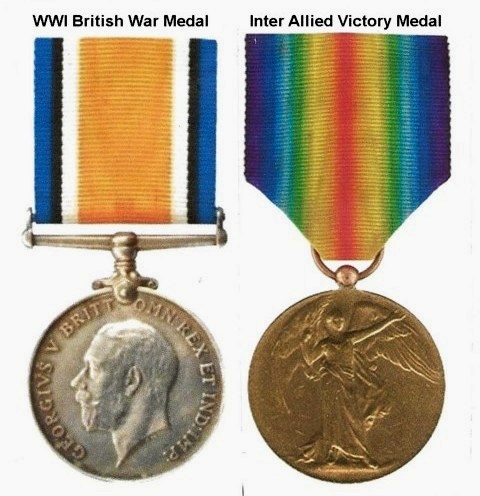
For his service and sacrifice, he was awarded the Volunteer Service Medal and the British War Medal.
Cecil Henry Mounce passed away on July 11, 1972. His story reflects the courage, endurance, and quiet heroism of a generation that faced unimaginable hardship and answered the call without hesitation.
As noted in Maclean’s (September 1996):
“The military is the single calling in the world with job specifications that include a commitment to die for your nation. What could be more honorable?”
Private Mounce was among those who accepted that solemn duty—serving with honour, perseverance, and unwavering devotion to his country.
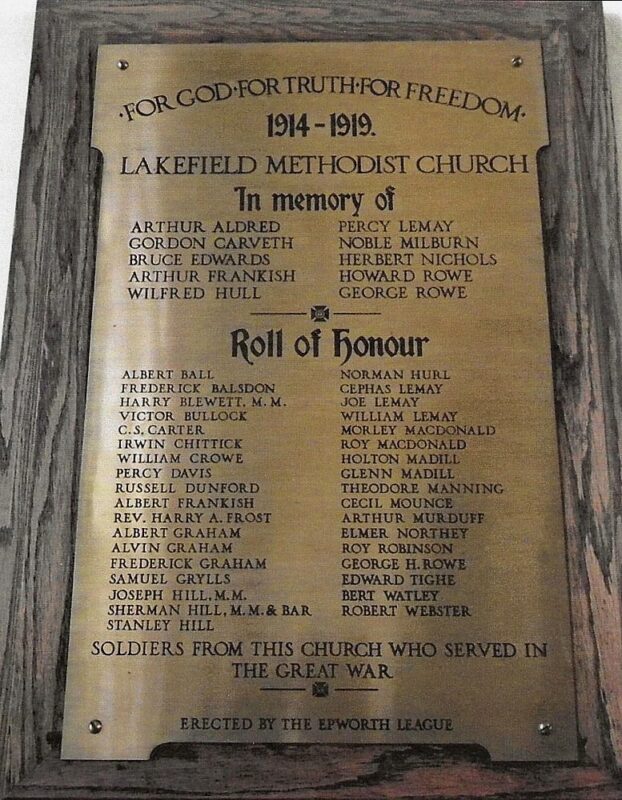
Cecil Henry Mounce was a member of the Lakefield Methodist church and is included on the Memorial Plaque which honours their members who served in the Armed forced during World War 1. The plaque currently hangs in the sanctuary of the Lakefield United Church 47 Regent Street, Lakefield Ontario.
PERSONAL HISTORY
CECIL HENRY MOUNCE
Cecil Henry Mounce was born in Sault Ste. Marie on July 13, 1892, the son of Mary Ann “Minnie” Carveth and William Henry Mounce. Cecil had an older brother Clarence and a younger sister Vina. By 1897, Cecil’s mother had married William Sidney Manning and the family was living on Regent Street in Lakefield. Cecil received his education in the local schools and later he was living in Peterborough and he was working as a boat builder. In May 1915, Cecil enlisted in Peterborough to serve his King and Country. After the war, Cecil returned to Peterborough and a year later he married Bertha Jessie Record in Peterborough on June 16, 1919. Bertha Jessie Record was born on July 18, 1894, daughter of Jessie Telford and Richard Alfred Record. They had a son Roy Henry Mounce born on June 17, 1929. Bertha passed away on June 22, 1971 and Cecil died on July 11, 1972; both are buried in Little Lake Cemetery in Peterborough, ON.