MILITARY HISTORY
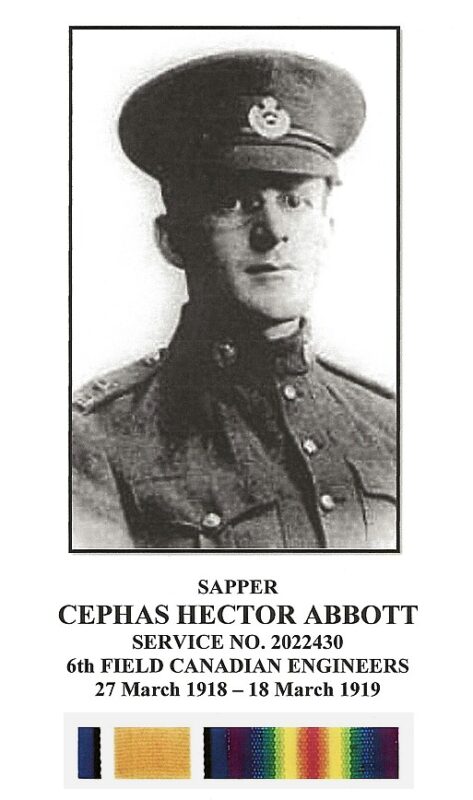
SAPPER CEPHAS HECTOR ABBOTT – No. 2022430– Active Service (World War I)
Sapper Cephas Hector Abbott stands as a proud example of the quiet, steadfast heroism that defined Canada’s soldiers in the First World War. On March 27, 1918, at the age of 26, he stepped forward in Vancouver, British Columbia, to join the Canadian Active Service Force. An unmarried man from Lakefield, Ontario, he pledged himself to serve for the duration of the war—an act of courage rooted in duty rather than expectation.
Born October 7, 1890, Abbott had built his civilian life through honest trades—plumbing, tinsmithing, and vulcanizing. With no prior military experience, he nonetheless answered the call of his country. He was described as 5 feet 7½ inches tall, with a fair complexion and steady brown eyes—ordinary features for an extraordinary commitment.
Service as a Canadian Sapper
After training in St. John, Quebec, Abbott was assigned to the 6th Field Company, Canadian Engineers, a unit with a proud history of service and sacrifice. Sappers were the backbone of military engineering—soldiers who built bridges under fire, cleared minefields, demolished enemy fortifications, and carved roads through the chaos of war. Their work made every advance possible and every defense stronger.
Abbott sailed for England and arrived on July 26, 1918. Though he was not deployed to France before the Armistice, his role in engineering support was vital to the Canadian war effort. The 6th Field Company itself had been active since 1911, serving in both World Wars and standing ready in peacetime to aid communities during floods and natural disasters. Abbott was part of a legacy of resilience and service that shaped Canada’s military identity.
Love Amid the Aftermath of War
With the war’s end, Abbott was granted permission to marry on December 17, 1918. On January 5, 1919, he wed Mary Ellen Squires in the Leaford Parish Church—a moment of hope and new beginnings after years of global turmoil.
Sacrifice Beyond the Battlefield
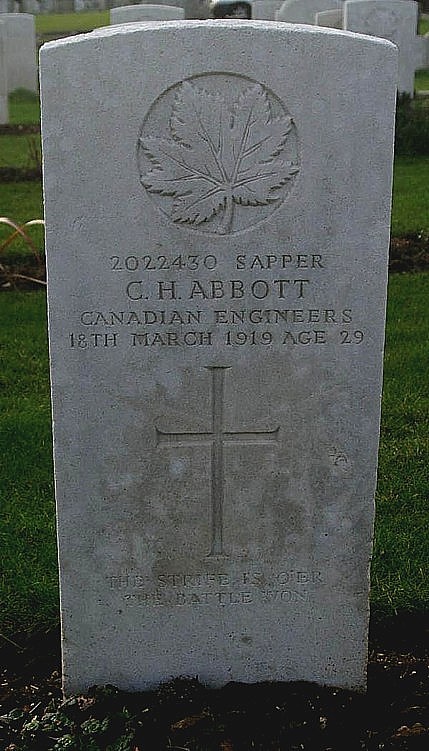
Tragically, the Spanish Flu pandemic swept through military camps and civilian populations alike. On March 15, 1919, Sapper Abbott was admitted to hospital with the illness. Three days later, on March 18 at 5:20 a.m., he passed away—one of the countless soldiers whose service ended not in battle, but in the final global hardship of the war.
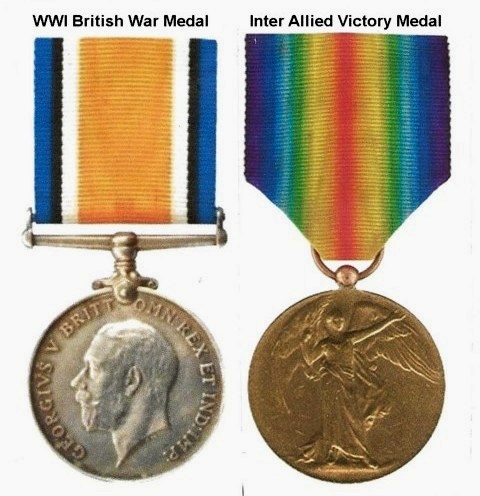
He had served one full year in England. For his dedication, he was entitled to the Volunteer Service Medal, the British War Medal, and his wife received the Memorial Cross, a symbol of Canada’s gratitude for the ultimate sacrifice.
A Legacy of Honour
Barbara Amiel wrote in Maclean’s in 1996:
“The military is the single calling in the world with job specifications that include a commitment to die for your nation. What could be more honorable?”
Sapper Cephas Hector Abbott lived—and died—within that noble calling. His story is one of patriotism, quiet bravery, and unwavering service. His sacrifice, like that of so many Canadians, helped shape the freedoms and peace that future generations would inherit.
PERSONAL HISTORY OF CEPHAS HECTOR ABBOTT
Cephas Hector Abbott was born in Lakefield on October 7, 1890, the only son of Charlotte and Edward Abbott. Cephas had three sisters. It was in November of 1894 that the family decided to move west to Mission, B.C. Cephas received his schooling out west and later worked as a tinsmith, plumber and vulcanizer. On December 8, 1912, Cephas married Annie Maud Adshead in Mission City, B.C. She was the daughter of Esther Elsam and John Samuel Adshead. We have not learned what happened to this marriage. On March 27, 1918, Cephas decided to go to Vancouver B.C. and enlisted, as a single man, to serve King and Country. As soon as the war was over, Cephas married Mary Ellen Squires in Eastborne, Sussex, England on January 31, 1919.
Sadly, Cephas came down with the Spanish Flu and died three days later on March 18th, 1919. Sapper Cephas Hector Abbott is remembered with honour in the Seaford Cemetery, Seaford, Lewes District, East Sussex, England.
FAMILY HISTORY OF CEPHAS ABBOTT
The paternal grandparents of Cephas Hector Abbott were Jane Hurl and William Frederick Abbott. They lived in Douro Township and have a family of nine children. By 1911 William and Jane Abbott were living in New Westminster, B.C. Jane passed away on January 22, 1915 and William died on March 21, 1920; both are buried in the Hatzic Cemetery, Hatzic, Fraser Valley District, British Columbia.
The maternal grandparents of Cephas Hector Abbott were Isaac Snelgrove and Charlotte Anne Payne. They lived in Dummer Township, then Smith Township and finally settled in Lakefield. Isaac was a wagon maker and they had a family of eight children – Henry, Mary, James, Jacob, Isaac, Sarah, Charlotte and Moses. Isaac passed away on April 12, 1895 and Charlotte died on October 23, 1912; both are buried in Lakefield Cemetery.
The parents of Cephas Hector Abbott were Charlotte Ann Snelgrove born in Douro Township on September 29, 1858, and Edward James Abbott born in Dummer Township on December 11, 1860. They were married in Lakefield on March 29, 1882. Edward worked at the Pine Grove Cheese Factory as a cheesemaker and they had a family of four children – Mina Rosetta, Ira Melville, Cephas Hector and Etta May Abbott. In November 1894, the family moved west to Mission City, B.C. Edward was working as a farmer in 1901 and by 1911 Edward was a fruit grower and the family was living in New Westminster, B.C. Edward passed away on January 12, 1932 and Charlotte died on November 16, 1940; both are buried in Hatzic Cemetery, Hatzic, Fraser Valley District, British Columbia.