MILITARY HISTORY
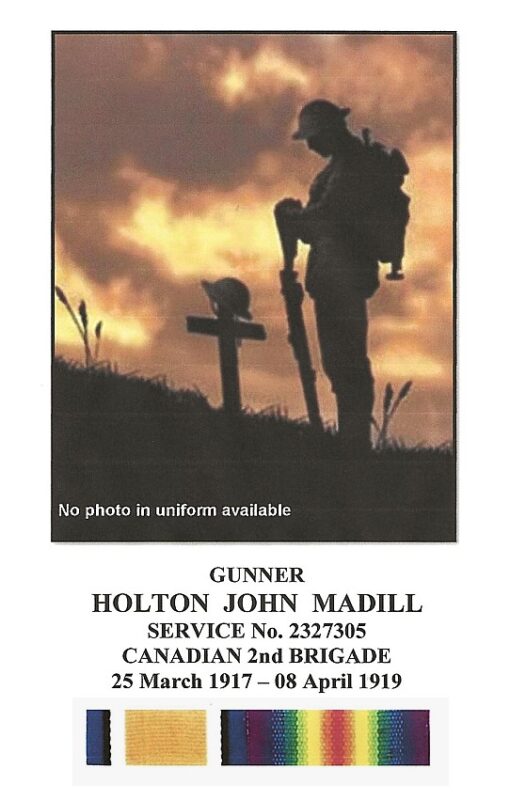
GUNNER HOLTON JOHN MADILL – No. 2327305 – Active Service (World War I)
Holton John Madill’s journey into the First World War reflects the spirit of an entire generation of young Canadians who stepped forward not for glory, but for honour, responsibility, and the hope of a safer world. His story is one of quiet bravery—an ordinary young man who answered an extraordinary call.
Early Life and Enlistment
Holton was born on December 4, 1895, in Lakefield, Ontario, a small community whose sons would go on to serve across the world. On March 25, 1917, at just 21 years old, he travelled to Belleville, Ontario, to enlist in the Canadian Active Service Force. He was unmarried, with his father, Walter Madill, listed as his next of kin. His civilian life had been spent working as a druggist—a profession rooted in care and precision—yet he willingly set it aside to join the war effort.
He stood 5 feet 7½ inches tall, with a medium complexion, grey eyes, and brown hair. With no previous military experience, he entered service as so many did: determined, untested, and ready to learn whatever the war demanded of him.
Training and Preparation for War
Holton received his training with the Cobourg Heavy Battery, a unit specializing in the operation of large artillery pieces. This training was rigorous and physically demanding. Heavy artillery required strength, teamwork, and technical skill. Every shell weighed dozens or even hundreds of pounds; every gun emplacement required coordination and endurance.
By the time his training was complete, Holton had transformed from a civilian druggist into a capable artilleryman.
Crossing the Atlantic
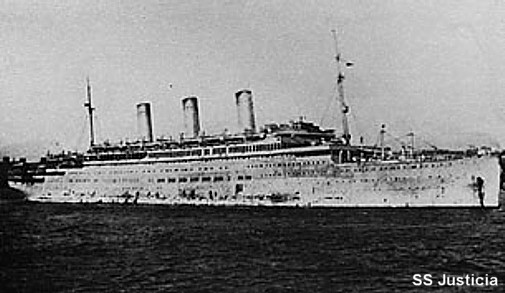
On June 25, 1917, Holton boarded the SS Justicia with the Canadian 2nd Brigade. The voyage across the Atlantic was long and dangerous. German U‑boats prowled the waters, and every soldier aboard knew the risks. When the ship arrived safely in Liverpool on July 5, 1917, the men stepped onto British soil with a mixture of relief and anticipation.
Holton was soon transferred to the Canadian 4th Siege Battery, a unit destined for some of the most intense and strategically critical work of the war.
The Role of the Siege Battery
The Siege Batteries of the Royal Garrison Artillery were among the most powerful forces on the Western Front. They operated massive howitzers—6‑inch, 8‑inch, 9.2‑inch, and even 12‑inch guns mounted on railways or heavy platforms. These weapons were capable of hurling enormous shells miles behind enemy lines.
Their mission was essential to every major offensive:
-
Destroy enemy artillery positions
-
Demolish fortified strongpoints and bunkers
-
Target supply depots, ammunition dumps, and rail lines
-
Break the enemy’s ability to reinforce or retreat
Gunners like Holton lived under constant threat. Enemy counter‑battery fire sought to silence them. The guns themselves were dangerous—recoil, misfires, and explosions were ever‑present risks. The work was exhausting, often carried out in mud, rain, and freezing cold. Yet without the Siege Batteries, infantry advances would have been impossible.
Holton served in France beginning November 22, 1917, during a period of relentless fighting. His battery would have supported operations during the final year of the war, when Canadian forces played a decisive role in breaking the German lines.
After the Armistice
When hostilities ceased on November 11, 1918, Holton’s service did not end immediately. Artillery units remained in Europe to secure equipment, dismantle positions, and support the transition to peace. He returned to England on February 14, 1919, and then to Canada, where he was formally discharged in Kingston on April 8, 1919. He listed his home address as Toronto, Ontario.
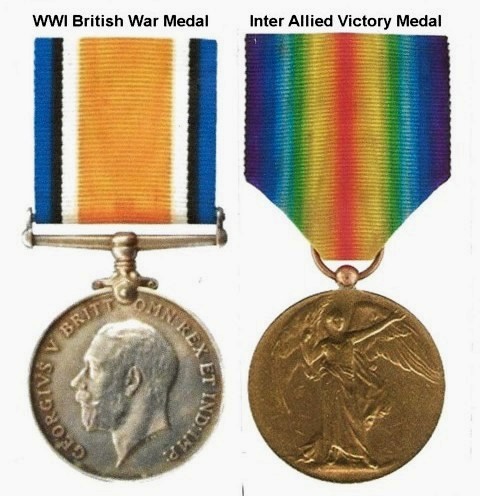
Holton had served two full years—one in England and one in France. For his dedication, he earned the Volunteer Service Medal and the British War Medal, recognizing his contribution to the Allied victory.
A Life After War
Holton returned to civilian life, carrying with him the experiences and memories of a generation forever changed by war. He lived until April 27, 1969, passing away at the age of 73. He is buried in Frankford, Hastings County, Ontario—a peaceful resting place far from the thunder of the guns he once served.
Honour and Legacy
Holton John Madill’s service reflects the courage of thousands of Canadians who stepped forward in the First World War. They were not professional soldiers; they were farmers, clerks, labourers, students, and tradesmen. Yet they became gunners, sappers, infantrymen, and officers—ordinary people performing extraordinary acts.
Barbara Amiel captured this truth in Maclean’s magazine:
“The military is the single calling in the world with job specifications that include a commitment to die for your nation. What could be more honourable?”
Holton lived that commitment. His story stands as a reminder that heroism is often quiet, steady, and unassuming—and that the freedoms enjoyed today were built on the sacrifices of men like him
PERSONAL HISTORY
HOLTON JOHN MADILL
Holton John Madill was born in Lakefield, Ontario, on December 4, 1895, the son of Florence Washburn and Walter Madill. He received his education in the local schools. Both Holton and his brother Kenneth were members of the Lakefield Scouts Loon Patrol. Holton was working as a druggist when he decided to enlist in Belleville on March 25, 1917, and serve his King and Country. After two years in the military, Holton returned home in 1919. By 1921, he was living in Belleville and back working as a druggist. On September 6, 1921, he married Lottie Helen Boyle in Peterborough. She was the daughter of Catherine Bethune and William Boyle. They had a family of two boys – William “Bill” Walter Madill and John Holton Madill. Sadly, Holton passed away on April 27, 1969, and Lottie died on September 26, 1973; both are buried in Holy Trinity Anglican Cemetery in Frankford, Ontario.
FAMILY HISTORY OF HOLTON JOHN MADILL
The parents of Holton John Madill were Florence Washburn born July 24, 1874, and Walter Madill born on April 3, 1871. They made their home in Lakefield and had a family of five children – Holton John, Russell Glenn, Kenneth Saxon, Florence “Bessie” and Walter “Ivan” Madill. Walter worked as a tinsmith and plumber. Florence passed away in 1924 and Walter died in 1954; both are buried in Lakefield Cemetery.